
The Satyam board said corporate governance, a clean record, management and organisational ability in operating a global company will be considered, apart from the financial bid and other technical criteria. The bidders will furnish an irrevocable and unconditional performance bank guarantee of Rs 100 crore to guarantee the deposit of funds required for the preferential allotment and the requisite escrow amounts for the public offer within four days of being selected.

Close to 20 regional stock exchanges, including the big exchanges of Delhi, Chennai, and Bengaluru, have voluntarily exited in the face of SEBI's stringent regulations. Namrata Acharya finds out what makes CSE continue to fight its lone battle.
SEBI will soon come out with new guidelines on public offers, including the introduction of the green-shoe option.

The Centre has no objection to a proposal for setting up a panel of domain experts to look into strengthening the regulatory mechanisms for the stock market, the Supreme Court was told on Monday while it was hearing pleas relating to the Adani stocks rout after the Hindenburg report.

Sebi to fix promoters' side deals with PE investors

Can only suspend non-compliant companies at present owing to a lack of jurisdictional clarity.

At a time when investors are preferring higher-risk investment products like thematic and small-cap mutual fund (MF) schemes, some fund houses are exploring the possibility of going further down the market-capitalisation (m-cap) ladder to unearth newer investment opportunities. HDFC MF had filed papers with the capital markets regulator - the Securities and Exchange Board of India (Sebi) - earlier this year for an active micro-cap scheme. Some more fund houses are keen on launching such schemes, say industry observers.

To safeguard investor interest, stock exchanges BSE and NSE on Wednesday advised their members to take extra caution while trading in nearly 400 illiquid stocks.

2017 saw the highest-ever mobilisation by way of IPOs of close to Rs 700 billion. The momentum is expected to continue this year as well.

Amazon has shot off yet another letter to market regulator Sebi, accusing Future Retail of insider trading and called for an investigation as the US online retailer looks to ratchet up pressure against the Future-RIL deal. Future Group, however, vehemently denied the charges, saying these allegations were "Amazon's ill-motivated attempts to throw everything at the situation to stultify the transaction."

As many as 49 players including Reliance Retail, Jindal Power Ltd and Adani group have submitted Expression of Interest (EoI) for acquiring the assets of debt-ridden Future Retail, which is currently going through insolvency resolution process. Reliance Retail Ventures Ltd, which is the holding company for retail operations of RIL and April Moon Retail Private Ltd, a joint venture between Adani Airport holdings and Flemingo group have again submitted their EOI, after the lenders of Future Retail decided to invite fresh bids after dividing FRL's assets into clusters. According to an update from FRL's Resolution Professional, the 49 players would be permitted to submit "resolution plan(s) for any/all such Clusters under Option II".

Sun Pharma was the top loser in the Sensex pack, shedding 2.37 per cent, followed by HCL Tech, Reliance Industries, IndusInd Bank and L&T.

The success of recent IPOs and the stability in the secondary market are propelling many firms and investment bankers to remove their IPO plans.
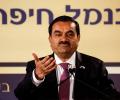
Weeks after it revised the rating outlook of two companies of embattled Adani group, S&P Global Ratings on Wednesday said it is watching for additional information on the conglomerate's governance and funding for any ratings action. Investors, it said, seek clarity on the credit impact of a string of allegations against the group in a short-seller report published in late January, and on the findings of a recently launched Supreme Court investigation. S&P Global published an FAQ-style commentary titled, "Adani Group: The Known Unknowns".
.jpg)
The Securities and Exchange Board of India (SEBI) unveiled new proposals, broadening the scope of who can be held liable for insider trading violations.
Sebi announced a four-stage penalty structure wherein fines increase with the passage of time.

For financial sector companies setting up shop in India, as of now the go-to regulators are obviously Sebi and the RBI with carve-outs for IRDAI or possibly PFRDA. But this could change soon with the International Financial Services Centres Authority, observes Subhomoy Bhattacharjee.

The telecom regulator on Friday released a list of 40 "defaulter" principal entities, including large banks like HDFC Bank, SBI and ICICI Bank, that are not fulfilling the regulatory norms on bulk commercial messages despite repeated reminders. Hardening its stance on the issue, the Telecom Regulatory Authority of India (TRAI) warned that defaulting entities should comply with the stipulated requirements by March 31, 2021 "to avoid any disruption in the communication with customers" from April 1, 2021. "As sufficient opportunity has been given to principal entities/ telemarketers to comply with the regulatory requirements and that the consumers cannot be deprived of the benefits of the regulatory provisions any further, therefore it has been decided that from April 1, 2021, any message failing in the scrubbing process due to non-compliance of regulatory requirements will be rejected" by the system, TRAI said in a statement.
According to sources, the market regulator is planning to introduce colour forms for client registration in a bid to stop brokers from making changes after a client has filled up the form. Currently, there are boxes each for cash derivatives and debt, and investors have to indicate whether they want to trade in the cash market or futures and options. In some cases, brokers themselves click on the derivatives option without the permission of the client.
India's capital market regulator on outlined a series of steps, including allowing short selling of equities by institutional investors, bringing mutual fund intermediaries under its purview.
The Securities and Exchange Board of India is considering its Primary Market Advisory Committee's recommendation to introduce a uniform face value system for all listed companies. At present, companies decide their individual face value between Rs 1 and Rs 100.

Indian firms mop up a meagre Rs 63 cr against Rs 247 cr raised in May.

Regulator, CIC were in court battle over disclosing names.

The next step for the Life Insurance Corporation of India is to approach market regulator Sebi, as the bank, which is also state-owned, is a listed entity.

The shares - close to 30% of the total holding - are expected to list on rival National Stock Exchange on or around February 3.

The income-tax (I-T) department is working on integrating the new e-filing portal with stock exchanges to help tax authorities track trade transactions, including futures and options. The integrated system will look at discrepancies between the data disclosed by an assessee and match it with data fetched from stock exchanges, using artificial intelligence, said two officials in the know. This will help detect and red-flag such matters, particularly those related to non-filers of income-tax return (ITR).

Of 194 entities thrown off the exchange, BSE doesn't have promoter names or addresses for 168 firms; yet it has ordered all promoters to buy back shares

A plea has been filed in the Supreme Court seeking investigation under the supervision of a sitting apex court judge against the Adani group of companies in light of the allegations made by the US-based Hindenburg Research.

The 'sudden volatility' in Adani stocks is entirely due to a series of events that was extreme and unique, and played out in too short a period. Investors and regulators pretended that it wasn't so. But then, along came Hindenburg, which forced some eyes to open, points out Debashis Basu.

A fundraising boom in the domestic market and tightening of the regulatory framework for overseas issues are responsible for this trend.

Fintech firm MobiKwik on Monday filed a draft red herring prospectus (DRHP) with the markets regulator, Securities and Exchange Board of India (Sebi), for its initial public offering (IPO). According to its DRHP, the company plans to raise Rs 1,900 crore, which includes a fresh issue of Rs 1,500 crore and an offer for sale of Rs 400 crore. The selling shareholders include American Express Travel, Bajaj Finance, Cisco Systems and Sequoia Capital India, besides founder Bipin Preet Singh. MobiKwik is the latest among tech majors wanting to list on stock exchanges. Food delivery start-up Zomato will launch its IPO on Wednesday.

Other measures being considered include relatively stringent KYC norms and a separate standard operating procedure for approval, renewal, and fresh investment from India's neighbouring countries.

Eleven years on, while 80% of scam-hit investors have been fully compensated, more than 50% of the sum is yet to be distributed.

Privatisation-bound Bharat Petroleum Corporation Ltd (BPCL) on Thursday said it has no intention to sell a part of its stake in Petronet LNG Ltd and Indraprastha Gas Ltd (IGL) to help its new owner avoid making an open offer for the two gas companies. BPCL holds 12.5 per cent of the shareholding in India's largest liquefied natural gas importer, Petronet, and a 22.5 per cent stake in city gas retailer, IGL. It is a promoter of both the listed companies and holds board positions.

Poor disclosure among India-listed firms is a turnoff for foreign investors.

Adani Group on Friday launched its Rs 31,000-crore open offer to acquire 26 per cent additional stake from the public shareholders of Swiss firm Holcim's two Indian listed entities ACC Ltd and Ambuja Cements. In May this year, the Adani Group had announced that it had clinched a deal to acquire a controlling stake in Holcim Ltd's businesses in India for $10.5 billion. Markets regulator Sebi granted approval for the open offer last week.

India's stock exchanges have decided to jointly introduce the T+1 settlement cycle in phases from February 25, beginning with the bottom 100 stocks by market capitalisation. From March 2022, on the last Friday (or the immediate next trading day) of every month, the next 500 stocks from the bottom will be subject to T+1 settlement. The phase-wise implementation is expected to give all market participants, including foreign portfolio investors (FPIs), ample time to shift to the shorter cycle. The settlement cycle represents the time period within which the stock exchanges have to settle security transactions.
